
Introducing a New Initiative to Advance Regenerative Building Practices
November 2026 | Calgary, Alberta
As the architecture and construction industries respond to the urgent need to reduce greenhouse gas emissions, there is growing recognition that the environmental impact of buildings extends far beyond their operational energy consumption.
The materials we select, the systems we design, the way buildings are manufactured and constructed, and the decisions made throughout their life cycle all contribute to their overall environmental impact.
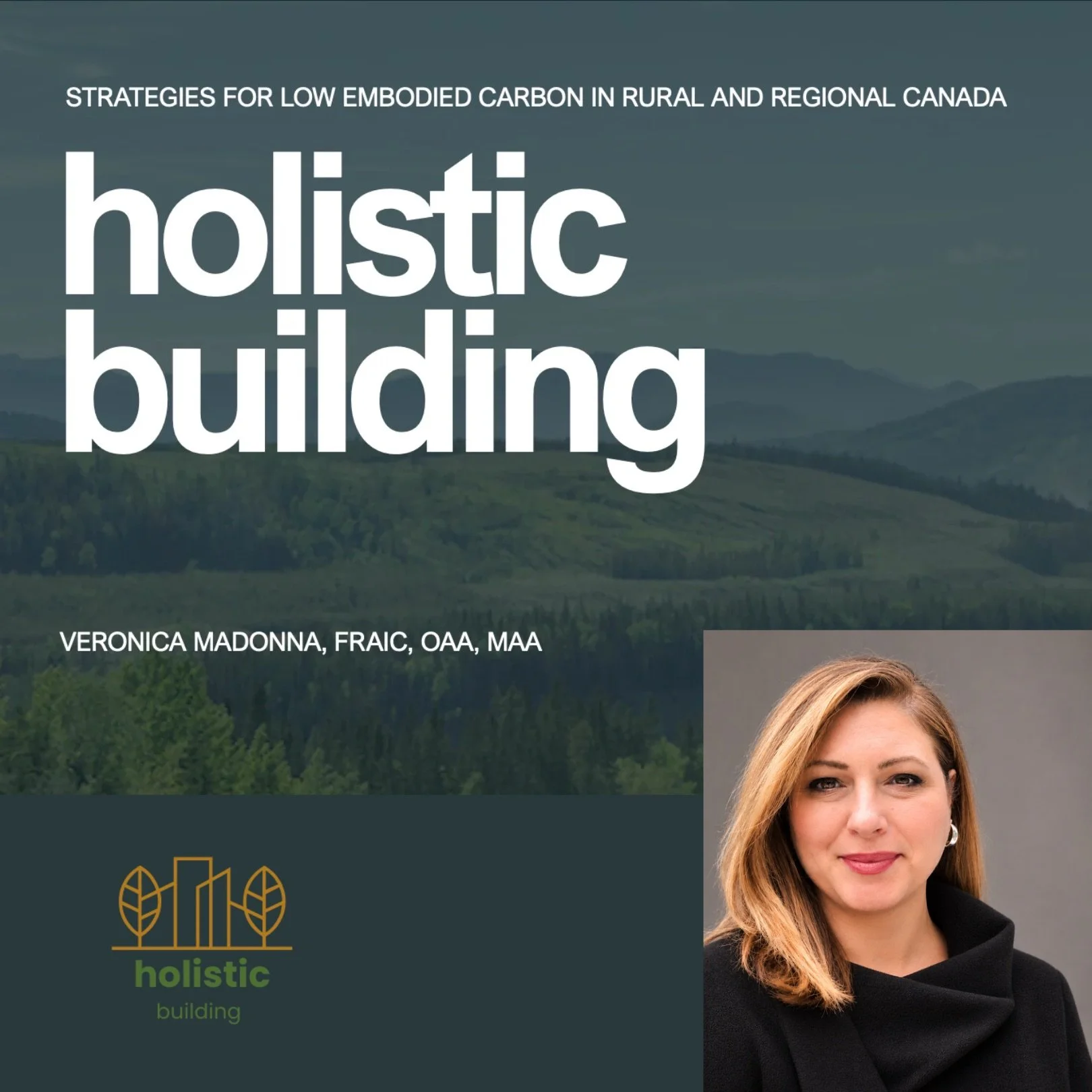
At the Wood Solutions Conference in Calgary, hosted by WoodWorks Alberta and the Canadian Wood Council, Veronica Madonna, Principal Architect at Studio VMA and Associate Professor at Athabasca University, presented Holistic Building for Low Embodied Carbon, exploring how an integrated approach to building design and construction can support a more sustainable and regenerative built environment.
The presentation also provided an opportunity to introduce Holistic Building, a growing research and educational initiative dedicated to advancing low-carbon building practices.
Explore the initiative: www.holisticbuilding.ca
Moving Beyond Material Selection
Reducing embodied carbon is increasingly recognized as a critical component of sustainable building design.
Embodied carbon represents the greenhouse gas emissions associated with building materials and construction processes, including material extraction, manufacturing, transportation, installation, maintenance, replacement, and end-of-life considerations.
While the adoption of lower-carbon materials is essential, meaningful reductions require a broader understanding of how materials, building systems, construction methods, and design decisions interact.
Mass timber, wood fibre insulation, and other biobased materials present important opportunities to reduce embodied carbon and support more regenerative construction practices.
However, the environmental benefits of these materials must be considered alongside factors such as regional availability, transportation, manufacturing processes, building performance, durability, and end-of-life strategies.
A holistic approach recognizes that no single material or technology provides a complete solution.
Instead, it encourages integrated decision-making that considers the environmental, economic, social, and cultural dimensions of building.
Introducing Holistic Building
Holistic Building is a research and educational initiative developed to bridge the gap between emerging knowledge in sustainable construction and its practical application within the building industry.
The initiative brings together research, education, and design resources to support architects, designers, builders, developers, and communities in making more informed decisions about how we build.
With a focus on low embodied carbon, biobased materials, and innovative construction methods, Holistic Building aims to make sustainable building strategies more accessible and actionable.
The platform is being developed to include:
Educational Resources
Online learning opportunities exploring embodied carbon, life cycle assessment, regenerative design, biobased materials, and modern methods of construction.
Practical Design Toolkits
Resources to support material selection, procurement, building system comparisons, and the integration of low-carbon strategies throughout the design and construction process.
Case Studies
Examples demonstrating how innovative building systems, material choices, and integrated design approaches can contribute to lower-carbon outcomes.
Decision-Making Tools
Resources to help project teams evaluate design alternatives, consider environmental impacts, and identify opportunities to reduce embodied carbon early in the project development process.
Together, these resources are intended to support a more informed, collaborative, and integrated approach to building.
The Role of Wood and Biobased Materials
Wood construction has an important role to play in Canada's transition toward a lower-carbon built environment.
From mass timber structural systems to wood fibre insulation and other emerging biobased products, wood-based materials offer opportunities to rethink conventional building assemblies and construction practices.
Beyond their potential carbon benefits, these materials can support regional manufacturing, innovative construction methods, and more resilient local supply chains.
However, realizing these opportunities requires greater collaboration between architects, engineers, manufacturers, contractors, researchers, and policymakers.
It also requires education and accessible tools that help project teams evaluate environmental impacts alongside cost, performance, constructability, and availability.
Holistic Building seeks to contribute to this transition by connecting research and industry knowledge with practical design applications.
Building a More Regenerative Future
The future of sustainable architecture requires more than incremental improvements to conventional building practices.
It requires a fundamental shift in how we understand the relationship between buildings, materials, resources, people, and the environment.
A regenerative approach challenges us to consider not only how to reduce environmental harm, but also how buildings can contribute positively to the ecological and social systems in which they exist.
Through research, education, and collaboration, Holistic Building aims to support this broader transformation.
The initiative is continuing to evolve, with additional educational content, case studies, and practical resources in development.
We invite architects, designers, builders, educators, manufacturers, and communities to explore the initiative and join the conversation about the future of low-carbon building.
Discover Holistic Building
Visit www.holisticbuilding.ca to learn more about the initiative and follow the development of new educational resources and tools.
Holistic Building is a research and educational initiative focused on advancing low-carbon, biobased, and regenerative building practices through integrated design thinking, education, and practical industry resources.